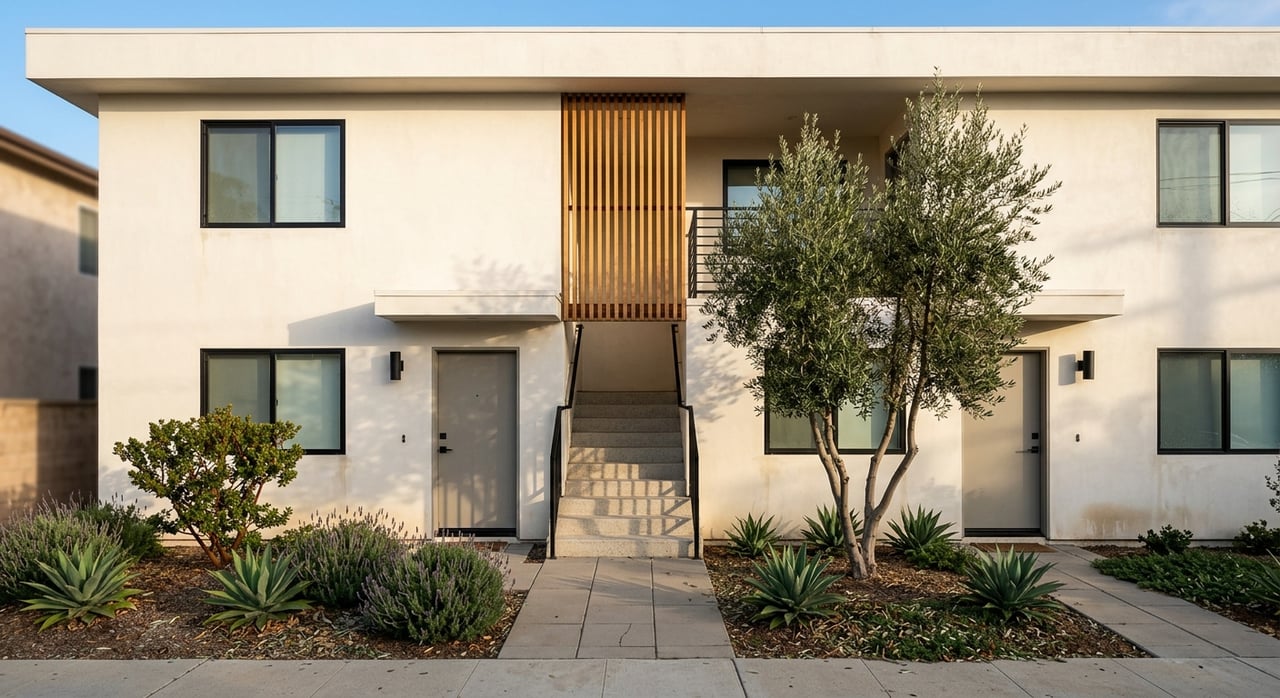
Van Nuys Duplex Triplex Investing: Key Basics
May 21, 2026
May 21, 2026
Wondering whether a Van Nuys duplex or triplex could be a smarter investment than a single rental home? You are not alone. Small multifamily properties can offer more than one income stream, but in Los Angeles they also come with local rules, fees, and underwriting details that matter from day one. If you want a practical starting point, this guide will walk you through the basics so you can evaluate opportunities with more confidence. Let’s dive in.
Van Nuys gives investors access to a large San Fernando Valley market with a mix of housing types, major streets, and rental demand across different unit sizes. For duplexes and triplexes, location is not just about the neighborhood name. It is also about corridor placement, traffic patterns, and the feel of the immediate block.
The Van Nuys-North Sherman Oaks community plan notes that multifamily areas are concentrated along arterials like Sepulveda Boulevard, Sherman Way, Burbank Boulevard, Vanowen Street, and Magnolia Boulevard. That means when you compare properties, you should look closely at where the building sits in relation to those corridors. Two properties with similar unit counts can perform differently based on street exposure and block context.
Public market snapshots also help frame the conversation. Current Zillow data for Van Nuys shows an average home value of $805,995 and a median sale price of $770,583. In the 91405 ZIP code, Zillow reports an average rent of $2,299, with current average rents around $1,845 for one-bedroom units, $2,595 for two-bedroom units, and $3,500 for three-bedroom units.
A duplex or triplex often appeals to investors because the income stream is spread across more than one unit. If one unit becomes vacant, you may still have rent coming in from the others. That does not remove risk, but it can change how you think about vacancy compared with a one-unit rental.
At the same time, small multifamily usually brings more operational complexity than a single-family rental. In Los Angeles, parcels with two or more residential units and at least one rented unit may fall under the city’s Systematic Code Enforcement Program, also called SCEP. That creates an added compliance layer that many one-unit rentals do not face in the same way.
This is one reason it helps to avoid broad rules of thumb. A duplex or triplex may look attractive on gross rent alone, but the better test is whether the actual unit mix, local rent bands, and city-related costs support the numbers.
In Van Nuys, unit mix matters because rent data is often segmented by bedroom count. Instead of applying one blended rent number across the whole property, you will usually get a better first-pass estimate by comparing each unit to local asking-rent bands for similar bedroom counts.
For 91405, Zillow currently shows average rents of:
Those figures are useful public benchmarks, but they are not duplex-only or triplex-only comps. They are broader ZIP-code snapshots. That means you should treat them as a screening tool, not a final underwriting answer.
Zillow also labels the 91405 rental market as “cool,” with 199 available rentals and year-over-year rent essentially flat. For you as an investor, that is a reminder to stay disciplined. If rents are not moving quickly, your projections should be grounded in current market conditions rather than hopeful future jumps.
For Van Nuys properties inside the City of Los Angeles, local housing rules can have a major impact on cash flow and value-add plans. One of the first questions to answer is whether the property is covered by the Rent Stabilization Ordinance, or RSO.
LAHD states that rental property built on or before October 1, 1978 is generally subject to the RSO. LAHD also says RSO coverage includes duplexes and two or more single-family dwelling units on the same parcel. By contrast, a single-family home that is the only residential structure on the parcel is not subject to the RSO.
If a property is RSO-covered, the current allowable annual rent increase is 3%, according to LAHD. LAHD also states that landlords can no longer add a utility percentage increase. RSO units must be registered annually, and the annual registration certificate must be provided to the tenant.
That makes RSO status a core underwriting item, not a side note. If you are evaluating a duplex or triplex with below-market rents, you need to know whether the current rent roll can realistically move at the pace your pro forma assumes.
Another key cost driver is SCEP. LAHD says SCEP applies to properties with two or more residential units on a parcel and at least one rented unit. The current SCEP fee is $67.94 per unit per year.
LAHD also states that with proper notice, an owner may pass through half of that fee to the tenant at $2.83 per month. Even so, the fee should still be built into your operating budget from the start. Small properties can be very sensitive to recurring costs, especially when only two or three units are carrying the expense load.
If a unit is not subject to the RSO, another local fee may still apply. LAHD lists the Just Cause Enforcement Fee at $31.05 per unit effective January 2025 for rental units not subject to the RSO. This is another reason your due diligence should separate RSO and non-RSO assumptions instead of treating all units the same.
Many investors look at duplexes and triplexes as value-add opportunities. That may include upgrades, deferred maintenance work, or a broader repositioning plan. In Los Angeles, you should be cautious about assuming that renovation automatically leads to immediate market-rate rent resets.
LAHD has approval-based pathways related to capital improvements, primary renovations, rehabilitation, and just-and-reasonable rent increases for RSO-covered properties. In practice, that means your timeline and cost assumptions should reflect the local approval process. If your investment thesis depends on fast rent increases after improvements, this is an area to review very carefully.
Small multifamily financing can also look different from a standard single-family purchase. The good news is that common financing options do exist for 1-4 unit properties, including duplexes and triplexes.
HUD says FHA-insured loans are available on 1-4 unit properties, with down payments as low as 3.5% of the purchase price. For buyers planning to live in one unit, that can be an important entry point into multifamily ownership.
Fannie Mae says rental income from a two- to four-unit principal residence can be used in qualifying when you occupy one unit. It also uses the Small Residential Income Property Appraisal Report, known as Form 1025, for two- to four-unit properties. That can make owner-occupied multifamily purchases especially appealing if you want to offset part of your housing cost with rental income.
Freddie Mac’s current loan-to-value chart also shows why owner-occupant financing often has an edge. It allows up to 95% LTV for 2-unit primary residences, up to 80% for 3- and 4-unit primary residences, and 75% for 2- to 4-unit investment properties. In simple terms, buying as an owner-occupant may allow more leverage than buying purely as an investor.
Lenders also tend to require more documentation on these deals. Fannie Mae allows rental income from one- to four-unit investment properties and 2- to 4-unit principal residences, but lenders still look for leases, tax returns, and appraisal support. So if you are moving from single-family buying into duplex or triplex investing, expect a more detailed file.
Before you get too attached to a property, it helps to run a basic screening process. A clear checklist can save you time and help you spot weak assumptions early.
Here are some of the most important questions to ask:
This kind of screening is especially useful in Van Nuys because the market is not one-size-fits-all. Corridor location, unit layout, and rent-control status can all change the story.
You do not need to rely on one number from one source. A smart first pass often combines public data points to pressure-test the opportunity. The research here suggests using Census ACS housing tables, Zillow rent snapshots, and LAHD RSO and rent-registry resources as a practical starting framework.
ACS housing tables can provide median gross rent and rental vacancy metrics that help you sanity-check broader market assumptions. Zillow can offer current asking-rent snapshots by bedroom count. LAHD can help you verify whether the property may be subject to local rent rules and registration requirements.
That combination will not replace property-specific due diligence, but it can help you spot deals that need a closer look before you spend more time or money.
A Van Nuys duplex or triplex can look straightforward on the surface, but the details matter. Rent-control status, corridor location, unit mix, inspection fees, and financing structure all shape whether a deal works for your goals.
That is why local guidance can be valuable, especially if you are comparing owner-occupant and investor paths, reviewing tenant-occupied properties, or weighing a future renovation strategy. When you have a team that understands small multifamily in the San Fernando Valley, you can move with more clarity and fewer surprises.
If you are thinking about buying, selling, or evaluating a duplex or triplex in Van Nuys, Team Amalia-K can help you look at the numbers, the local context, and the practical next steps with a steady, relationship-first approach.
Stay up to date on the latest real estate trends.
We pride ourselves on informing and educating our clients in order to make better real estate decisions. Contact us today to find out how we can be of assistance to you!
Get In Touch With Our Team To Learn More

Team Amalia-K
[email protected]
(818) 281-8407
Amalia Khachikian | CA DRE# 00989919
Tina Mansoorian | CA DRE# 02102141
Serli Tasci | CA DRE# 02047320
14141 Ventura Blvd # 8 Sherman Oaks CA 91423